


Could you briefly introduce yourself and your farm?
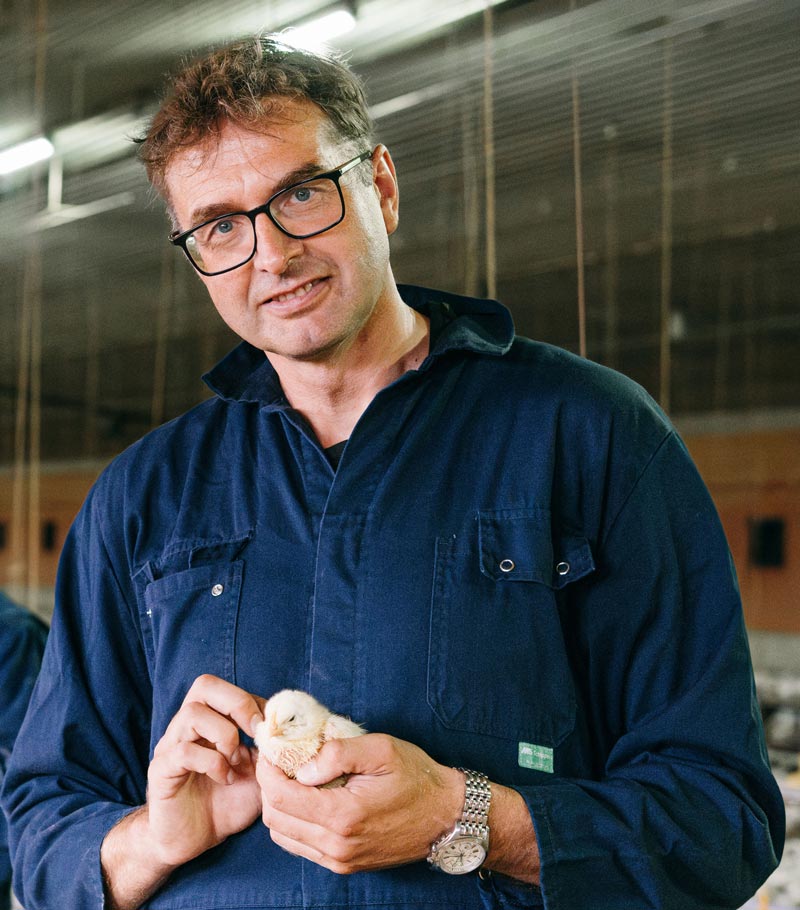
My name is Philipp Beckhove and I run our family farm, Hof Beckhove, in Senden/Ottmarsbocholt in the Münsterland region. On our farm we grow crops, raise pigs and broiler chickens, and invest in renewable energy. In several modern barns, I focus strongly on sustainable and animal-friendly poultry production. Recently, we started with on-farm hatching where we place the eggs in the barn so that the chicks directly hatch stress-free in the poultry house.
What challenges did you face on your farm, and why was it important to address them?
One major challenge is keeping an eye on the animals’ behavior at all times. Without precise monitoring, stress, restless flocks, or uneven growth rates can develop quickly. For animal welfare and economic efficiency, this is a crucial point.
What “good practice” did you use to tackle this problem?
I installed an AI-supported camera technology in the barn. Around 48 cameras analyze the animals’ movements, feeding behavior, and activity patterns in real time. This allows us to detect problems rather quickly so we can react immediately, for example by adjusting ventilation, heating, or feeding. In addition, we use a structured lighting program that supports the animals’ day–night rhythm and creates a calmer atmosphere in the barn.
What changed after you implemented this “good practice”?
Since introducing AI monitoring, we have much better control over the barn climate and the animals’ behavior. Any irregularities become visible immediately, allowing us to intervene early. This reduces stress and disease and noticeably improves animal welfare. Efficiency and predictability have also increased. The targeted lighting program further contributes to a calmer barn, more consistent feed intake, and fewer stress situations overall.
What advice would you give to other broiler farmers struggling with similar problems?
Don’t rely solely on gut feeling — measure, monitor, document! Small changes in climate or behavior can have major consequences. With reliable data, you can recognize problems before they arise.
What is the most important lesson you take from this experience?
Technology is only as good as how you use it. In combination with attentiveness and good barn management, prevention is always cheaper and more effective than corrections later on. Good management today means observing, analyzing, reacting — not stepping in only once it’s already too late.