


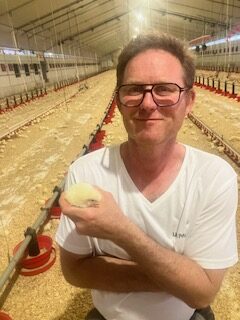
Could you briefly introduce yourself and your farm?
My name is Louis-Marie Pasquier, and I have been a poultry farmer since 1995 in the Deux-Sèvres department, in France. I run the farm together with my wife, and we employ one full-time worker and one apprentice. Our facilities cover 11,000 m² across 9 multipurpose broiler/poultry houses (used for broilers, ducks, guinea fowl, and turkeys) spread over 4 rearing sites, all operating under longitudinal dynamic ventilation. We rear conventional broilers under the “Nature d’Éleveurs” charter, with a maximum of 20 batches per year.
What challenge were you facing on your farm, and why was it important to solve it?
Infectious Skin Lesions (ISL): The most recent issue I encountered was Infectious Skin Lesions (ISL). They present as superficial scratches beneath the skin of the thighs, leading to fibrin deposition that forms a characteristic veil-like layer over the intestines and organs. What makes them particularly tricky is that they tend to go unnoticed on the farm, causing only a slight drop in Average Daily Gain (ADG) or minor mortality, but only become apparent at slaughterhouse, where they can result in condemnation rates of 1 to 3%, depending on the severity of the lesions observed.
Nest-Born: To counter the stress associated with hatching at the hatchery followed by transport, my production organisation suggested I trial on-farm hatching using the Nest-Born system.
Which Good Practice did you use to tackle this challenge?
ISL: To tackle the ISL problem, I first tried vaccination against E. coli, which initially yielded good results but showed its limitations over time, with some batches continuing to display ISL issues. The return on investment for vaccination is therefore not guaranteed, especially given the high cost of the vaccine. Additionally, I had identified a ventilation issue between 15 and 25 days of age at one of my sites (inadequate negative pressure and over-ventilation were generating minor draughts and causing bird chilling). I raised this with my technical advisor, and over the following two batches, across 3 houses (approximately 3,000 m²), we adjusted the ventilation settings and minimum air requirements. The situation has improved significantly ever since.
Nest-Born: Over three batches, I trialled the Nest-Born on-farm hatching system in one poultry house. To do so, I had to start the house preheating three additional days earlier than usual. Just as with a standard protocol before chick delivery, the preheating began three days before egg arrival. Lighting is kept low to allow quiet hatching, until 12 hours before Day 0, when I raise the light intensity to 70%.
What changed on your farm after applying this Good Practice? (e.g., results, improvements, practical benefits)
ISL: I have not used any E. coli vaccination since the ventilation parameters were adjusted, that is, for about a year now, and as a result I am observing fewer condemnation rates and better techno-economic performance.
Nest-Born: With only three batches completed to date, I do not yet have enough hindsight to draw firm conclusions, but the early results are very encouraging. On the economic side, I have estimated an additional pre-heating cost of approximately €0.50/m² in gas for a house during winter. In return, I am observing a minimum ADG gain of one to one-and-a-half days (roughly 70–90 g), a slightly improved FCR, and a marked reduction in health issues (colibacillosis, enterococcal infections). Beyond the production performance figures, the most striking difference compared to a conventional placement is at the startup stage. The Nest-Born system enables a truly “gentle, stress-free hatch”: the first chicks hatch 48 hours before D0, and 90% are hatched 24 hours before D0. Unlike chicks delivered at D0, those hatched on-farm take their time to move around, drink, and feed at their own pace, and reach behavioural patterns comparable to conventionally delivered day-old chicks by 3 to 4 days post-hatch.
What advice would you give to other broiler farmers dealing with a similar issue?
ISL: It is essential to take the time to discuss the challenges you encounter on your farm with your technical advisor, rather than immediately going for the easiest solution. In my case, vaccination was my first instinct, but it only addressed the symptoms without treating the root cause, and it cost me more at the end.
Nest-Born: If you are offered the chance to trial Nest-Born, go for it, it is well worth it. Personally, I was far from convinced at the outset, but now I would not go back to any other system.
What is the most important lesson you learned from this experience?
ISL: After 35 years in this profession, I remain convinced that you have to stay as close to your birds as possible, constantly attentive to their behaviour and welfare Nothing can ever be taken for granted when working with living beings, and I speak from experience. Everything is constantly changing – genetics, housing, husbandry practices – and we must evolve with it. Continually questioning your own methods is an essential condition for doing this job well and for safeguarding the health and welfare of your animals.
Nest-Born: Through the Nest-Born experience, I have come to better understand the importance of minimising stress in our poultry and chicks during transport and at delivery, because it makes all the difference for what comes next, though this is more of a sector-wide challenge. If we can eliminate these stressors, it would be a significant gain and would remove a many welfare and health issues. The limit is that, at present, too few hatcheries are equipped with these systems, so supply is still limited.